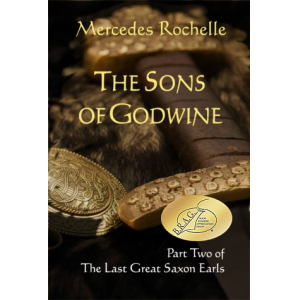
The Sons of Godwine: Part Two of The Last Great Saxon Earls
Description
<p>Emerging from the long shadow cast by his formidable father, Harold Godwineson showed himself to be a worthy successor to the Earldom of Wessex. In the following twelve years, he became the King's most trusted advisor, practically taking the reins of government into his own hands. And on Edward the Confessor's death, Harold Godwineson mounted the throne—the first king of England not of royal blood. Yet Harold was only a man, and his rise in fortune was not blameless. Like any person aspiring to power, he made choices he wasn't particularly proud of. Unfortunately, those closest to him sometimes paid the price of his fame.<br /><br />This is a story of Godwine's family as told from the viewpoint of Harold and his younger brothers. Queen Editha, known for her Vita Ædwardi Regis, originally commissioned a work to memorialize the deeds of her family, but after the Conquest historians tell us she abandoned this project and concentrated on her husband, the less dangerous subject. In THE SONS OF GODWINE and FATAL RIVALRY, I am telling the story as it might have survived had she collected and passed on the memoirs of her tragic brothers.<br /><br />This book is part two of The Last Great Saxon Earls series. Book one, GODWINE KINGMAKER, depicted the rise and fall of the first Earl of Wessex who came to power under Canute and rose to preeminence at the beginning of Edward the Confessor's reign. Unfortunately, Godwine's misguided efforts to champion his eldest son Swegn recoiled on the whole family, contributing to their outlawry and Queen Editha's disgrace. Their exile only lasted one year and they returned victorious to London, though it was obvious that Harold's career was just beginning as his father's journey was coming to an end.<br /><br />Harold's siblings were all overshadowed by their famous brother; in their memoirs we see remarks tinged sometimes with admiration, sometimes with skepticism, and in Tostig's case, with jealousy. We see a Harold who is ambitious, self-assured, sometimes egocentric, imperfect, yet heroic. His own story is all about Harold, but his brothers see things a little differently. Throughout, their observations are purely subjective, and witnessing events through their eyes gives us an insider’s perspective.<br /><br />Harold was his mother's favorite, confident enough to rise above petty sibling rivalry but Tostig, next in line, was not so lucky. Harold would have been surprised by Tostig's vindictiveness, if he had ever given his brother a second thought. And that was the problem. Tostig's love/hate relationship with Harold would eventually destroy everything they worked for, leaving the country open to foreign conquest. This subplot comes to a crisis in book three of the series, FATAL RIVALRY.</p>
Story Behind The Book
Author and forensic consultant Victoria Hargan reveals personality traits and characteristics that may be responsible for the high risk of domestic violence perpetrated by police officers. Police Personality and Domestic Violence offers a forensic psychological approach and review of literature on the scope of the problem when domestic violence is committed by a police officer. Research suggests that personality traits of police officers are similar to domestic abusers and that it is these very traits that make police officers effective at police work. Personality characteristics such as authoritative, aggressive, assertive, controlling and suspicious help the officer in his duties. These same personality traits are also negative traits in battering relationships. Domestic violence perpetrated by police officers is a result of multifaceted dynamics, including the individual police officer’s personality, police culture, police training, and exposure to violence on the job, a sense of entitlement, and influence of the administration of the police agency. These dynamics may predispose police officers to domestic violence. This book offers suggestions for the pre-selection of police candidates, in addition to reviewing the psychological instruments used in police selection. A must read for forensic evaluators, the law enforcement community, and the medical and mental health communities.