About
Angela Doll Carlson is a poet and essayist best known for her work as Mrs Metaphor found on her blog at Mrsmetaphor.com. She connects the dots of daily life in an attempt to humbly reach the deep "a-ha" we all seek. Angela began to write as Mrs Metaphor in 2006 and has maintained a modest but dedicated following ever since.
Her work has appeared most recently in Burnside Writer's Collective, St. Katherine Review, Rock and Sling, "Good Letters," Ruminate Magazine Blog and Art House America. Her first book, Nearly Orthodox: On Being a Modern Woman in an Ancient Tradition is due out from Ancient Faith Press in July 2014.
Angela currently lives in Chicago, IL with her husband, David and her 4 outrageously spirited yet remarkably likable children.
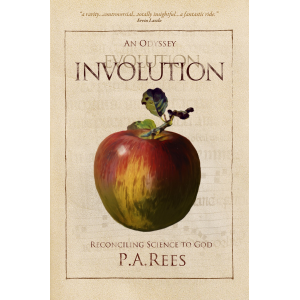
Involution-An Odyssey Reconciling Science to God
Description
<p>“<em>We are not human beings having a spiritual experience; we are spiritual beings having a human experience.”(</em>Teilhard de Chardin<em>)</em></p><p><span style="line-height:1.6em;"><em>Involution-An Odyssey Reconciling Science to God </em> is as layered as a French cassoulet, as diverting, satisfying and as rich. Each reader will spoon this book differently. On the surface it seems to be a simple and light-hearted poetic journey through the history of Western thought, dominantly scientific, but enriched with painting and music. Beneath that surface is the sauce of a new evolutionary idea, involution; the informing of all matter by consciousness, encoded and communicating throughout the natural world. A book about the cathedral of consciousness could have used any language to paint it, but science is perhaps most in need of new vision, and its chronology is already familiar.</span></p><p><span style="line-height:1.6em;">The author offers a bold alternative vision of both science and creation: she suggests that science has been incrementally the recovery of memory, the memory of evolution/involution</span><em style="line-height:1.6em;">.</em></p><p>“<em> Involution proposes that humans carry within them the history of the universe, which is (re)discovered by the individual genius when the time is ripe. All is stored within our DNA and awaits revelation. Such piecemeal revelations set our finite lives in an eternal chain of co-creation and these new leaps of discovery are compared to mystical experience</em>” (From a reviewer)</p><p>Each unique contributor served the collective and universal return to holism and unity. Thus the geniuses of the scientific journey, like the spiritual visionaries alongside, have threaded the rosary of science with the beads of inspiration, and through them returned Man to his spiritual nature and origin.</p><p><span style="line-height:1.6em;">The separation between experience and the rational intellect of science has, by modelling memory as theory, separated its understanding from the consciousness of all, and perceives mind and matter as separate, God and Man as distinct. This work is a dance towards their re-unification: Saints and scientists break the same bread.</span></p><p><span style="line-height:1.6em;">All of time and all the disciplines of science are needed for the evidence. Through swift (and sometimes sparring) Cantos of dialogue between Reason and Soul, Philippa Rees takes the reader on a monumental journey through the history of everything – with the evolution of man as one side of the coin and involution the other. The poetic narrative is augmented by learned and extensive footnotes offering background knowledge which in themselves are fascinating. In effect there are two books, offering a right and left brain approach. The twin spirals of a DNA shaped book intertwine external and internal and find, between them, one journey, Man’s recovery of Himself., and (hopefully) the Creation’s recovery of a nobler Man.</span></p><p><span style="line-height:1.6em;">From the same review “</span><em style="line-height:1.6em;">The reader who finishes the book will not be the same as the one who began it. New ideas will expand the mind but more profoundly, the deep, moving power of the verse will affect the heart.</em></p><p><em>(Marianne Rankin: Director of Communications, Alister Hardy Trust)</em></p><p> </p>
Story Behind The Book
The ink is now dry yet on my new book, Garden in the East.
I’m excited to see this one come to life. It’s been a very different writing experience from Nearly Orthodox. The first time I sat down to put words to Garden in the East, I pushed through what felt like a brick wall with each chapter. The good news from that first draft was that I actually found a way to push through and get to whatever the other side happened to be. The bad news is that once there, I found more walls and piles of rubble. I didn’t like the first draft of the book. In fact, I think I probably hated it.
Voice played a part. I just could not quite nail the voice of the book. My essay work has a certain voice– vulnerable but still somewhat detached from the subject at hand. My memoir work, particularly Nearly Orthodox has yet another version of this vulnerable voice. In this case, though, the added rambling of memory played a significant part. When I write poetry, I focus on words that transcend, like diving into a deep lake on a clear, cold day. The voice here is immersive and rich. When I write for my personal training clients, I choose a more authoritative voice, knowledgeable, yet kind and patient.
But Garden in the East is a different animal altogether, and the first draft tried to hard to be the personal trainer voice. On re-reading, it felt like a bossy and full of know it all voice. I threw it away. I’m not the boss of you.
The second draft took the concepts I covered as a bossy coach and softened into the mush of my own struggle. I stuck it in a box for a month and then read it again to see if maybe it had blossomed while in the dark but, sadly, it hadn’t. No miracle had sprung from that draft while I was away. I hated that draft too.
Finally, I asked myself what I would want if I were the one reading the book. I would want someone to walk alongside me, someone who knew a little bit about the struggle and knew a little bit about a healthy response to the struggle. I’d want to read words that were rich, like poetry. I’d want to hear concepts that were foundational to my life too. I’d want some solid information that was not likely to shift like sand in the wind when the next fitness fad came to town.
And so, the third draft was written with the hope of being that voice, the voice of the person who cares about you and about me and about the things that are enduring. We’re grasping it together here in this garden, planting and watering and pruning and then sitting in awe of how miraculous we are.
I hope that the book I wrote comes close to the one I envisioned. I hope that the third draft voice and all the edited versions thereafter that worked to make that voice and these concepts clear will produce some fine moments for the reader.
I’m grateful to be able to do this work and for the thumbs up from Ancient Faith for this small patch of earth in which to plant this Garden in the East.