
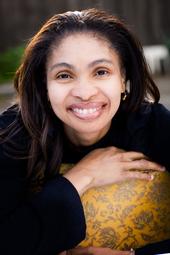
AnjuelleFloyd is the author of Keeper of Secrets…Translationsof an Incident, a collection of interconnected short stories, and a novel, The House, due for publication in Fall2010.
www.anjuellefloyd.com/books/keeper-of-secrets/
www.anjuellefloyd.com/books/the-house/
Anjuelleis a wife of twenty-seven years, mother of three, licensed Marriage and FamilyTherapist specializing in mother-daughter relations and dream work.
Agraduate of Duke University, she received her MA in Counseling Psychology fromThe California Institute of Integral Studies, San Francisco, she has attendedthe Dominican Institute of Philosophy and Theology, Berkeley, California.
Anjuellereceived a MFA in Creative Writing from Goddard College, Port Townsend,Washington. She has also received certificates of participation from TheHurston-Wright Writers’ Week and The Voices of Our Nations Writing Workshops.She teaches online fiction classes at Perelandra College.
Astudent of Process Painting for the last decade, Anjuelle has participated inThe Art of Living Black Exhibitions 2004, 2005, 2006, 2007, 2008, and 2009 heldat the Richmond Art Center, Richmond, California.
Anjuellefacilitates writing groups and provides individual consultation of fictionprojects. She also gives talks on TheNeed for Family, The Writing Process as a Path Toward Self-discovery and Healing.
Anjuellehosts the weekly blog talk radio show, Book Talk, Creativity and FamilyMatters
www.blogtalkradio.com/anjuellefloyd
Read Anjuelle’s blogs and more about her @ www.anjuellefloyd.com
and www.anjuellefloyd.wordpress.com
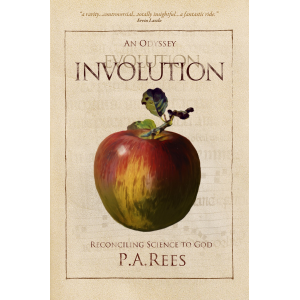
<p>“<em>We are not human beings having a spiritual experience; we are spiritual beings having a human experience.”(</em>Teilhard de Chardin<em>)</em></p><p><span style="line-height:1.6em;"><em>Involution-An Odyssey Reconciling Science to God </em> is as layered as a French cassoulet, as diverting, satisfying and as rich. Each reader will spoon this book differently. On the surface it seems to be a simple and light-hearted poetic journey through the history of Western thought, dominantly scientific, but enriched with painting and music. Beneath that surface is the sauce of a new evolutionary idea, involution; the informing of all matter by consciousness, encoded and communicating throughout the natural world. A book about the cathedral of consciousness could have used any language to paint it, but science is perhaps most in need of new vision, and its chronology is already familiar.</span></p><p><span style="line-height:1.6em;">The author offers a bold alternative vision of both science and creation: she suggests that science has been incrementally the recovery of memory, the memory of evolution/involution</span><em style="line-height:1.6em;">.</em></p><p>“<em> Involution proposes that humans carry within them the history of the universe, which is (re)discovered by the individual genius when the time is ripe. All is stored within our DNA and awaits revelation. Such piecemeal revelations set our finite lives in an eternal chain of co-creation and these new leaps of discovery are compared to mystical experience</em>” (From a reviewer)</p><p>Each unique contributor served the collective and universal return to holism and unity. Thus the geniuses of the scientific journey, like the spiritual visionaries alongside, have threaded the rosary of science with the beads of inspiration, and through them returned Man to his spiritual nature and origin.</p><p><span style="line-height:1.6em;">The separation between experience and the rational intellect of science has, by modelling memory as theory, separated its understanding from the consciousness of all, and perceives mind and matter as separate, God and Man as distinct. This work is a dance towards their re-unification: Saints and scientists break the same bread.</span></p><p><span style="line-height:1.6em;">All of time and all the disciplines of science are needed for the evidence. Through swift (and sometimes sparring) Cantos of dialogue between Reason and Soul, Philippa Rees takes the reader on a monumental journey through the history of everything – with the evolution of man as one side of the coin and involution the other. The poetic narrative is augmented by learned and extensive footnotes offering background knowledge which in themselves are fascinating. In effect there are two books, offering a right and left brain approach. The twin spirals of a DNA shaped book intertwine external and internal and find, between them, one journey, Man’s recovery of Himself., and (hopefully) the Creation’s recovery of a nobler Man.</span></p><p><span style="line-height:1.6em;">From the same review “</span><em style="line-height:1.6em;">The reader who finishes the book will not be the same as the one who began it. New ideas will expand the mind but more profoundly, the deep, moving power of the verse will affect the heart.</em></p><p><em>(Marianne Rankin: Director of Communications, Alister Hardy Trust)</em></p><p> </p>
The House On receiving the very thing she wants—a divorce and the power to sell their house—over which they have fought the past year—Anna Manning learns that Edward, her soon-to-be ex-husband is dying from cancer. A faithful wife for three decades, and stay-at-home mother of four children, Anna endured Edward’s constant absence due to travel for his international real estate firm and numerous extra-marital affairs. With their children now adults, Edward has less than six months, possibly three, to live. Anna takes him home to die in the house she has fought so vigorously to sell. But letting go of someone who has caused so much pain in your life doesn’t come easily. Edward has changed. There are Anna and Edward’s four children, three of whom who are married and struggling to endow their families with meaning and purpose. There is also Inman who loves Anna, and gives the one thing Edward denied her—passion and intimacy. And lastly there is Anna. An art history major turned wife and mother out of college, she had planned on divorcing Edward and with her proceeds from the sale of the house move to France. Anna would visit and study the works in Europe’s famous museums—perhaps work as a docent in one. News of Edward’s terminal illness provokes her to understand the present, rooted in a wellspring of the past and pouring into a future without him. The House shows what happens when one adopts the belief that: All hold regret and are seeking forgiveness. Our salvation rests in the hands of others—most particularly the ones we love, and who have treated us wrongly.