About
Born in Richmond, Virginia, and carted back and forth between Virginia and Baltimore, I blame my rootless, restless personality on my father. He was and is a traveling salesman with a keen gift of gab, great wit, a ready joke, and could sell white tennis shoes to coal miners.
It was during these sojourns up and down the east coast I soaked up the stories that would later be Tobacco Sticks and Mica Highways. I think authors should exploit their family history before raping the rest of the culture for material.
Dad finally got tired of the east and moved to the Midwest when I was fourteen. We settled outside of Chicago. It is here I came of age and went off to college for seven years -- two degrees and one novel later I returned to Chicago and lived in many different apartments, trying to get a little two hundred page manuscript called Ripples published.
When a local printer said he would take a chance on my book, I jumped and had my first novel published by a man who had never published anything. Great reviews and moderate sales put me back to my jobs as a janitor, baker, waiter, construction worker, teacher, real estate tycoon, mortgage broker, professor, security guard, salesman -- anything to make a buck and keep writing. The printer lost his mind and published my second novel, too. That landed me with Bantam after some rave reviews and a paperback auction for my second novel, Tobacco Sticks.
A third novel, Mica Highways, was sold on less than one hundred and fifty pages to Bantam and then I did a strange thing -- I settled down to writing in Ernest Hemingway's birthplace in Oak Park, Illinois. I have since been looking for the Great American Novel up in the old red oak rafters and I think I might have finally found one... we'll see.
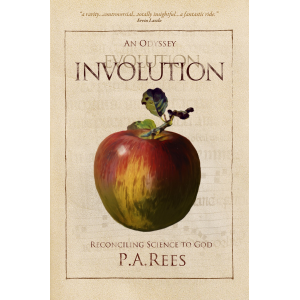
Involution-An Odyssey Reconciling Science to God
Description
<p>“<em>We are not human beings having a spiritual experience; we are spiritual beings having a human experience.”(</em>Teilhard de Chardin<em>)</em></p><p><span style="line-height:1.6em;"><em>Involution-An Odyssey Reconciling Science to God </em> is as layered as a French cassoulet, as diverting, satisfying and as rich. Each reader will spoon this book differently. On the surface it seems to be a simple and light-hearted poetic journey through the history of Western thought, dominantly scientific, but enriched with painting and music. Beneath that surface is the sauce of a new evolutionary idea, involution; the informing of all matter by consciousness, encoded and communicating throughout the natural world. A book about the cathedral of consciousness could have used any language to paint it, but science is perhaps most in need of new vision, and its chronology is already familiar.</span></p><p><span style="line-height:1.6em;">The author offers a bold alternative vision of both science and creation: she suggests that science has been incrementally the recovery of memory, the memory of evolution/involution</span><em style="line-height:1.6em;">.</em></p><p>“<em> Involution proposes that humans carry within them the history of the universe, which is (re)discovered by the individual genius when the time is ripe. All is stored within our DNA and awaits revelation. Such piecemeal revelations set our finite lives in an eternal chain of co-creation and these new leaps of discovery are compared to mystical experience</em>” (From a reviewer)</p><p>Each unique contributor served the collective and universal return to holism and unity. Thus the geniuses of the scientific journey, like the spiritual visionaries alongside, have threaded the rosary of science with the beads of inspiration, and through them returned Man to his spiritual nature and origin.</p><p><span style="line-height:1.6em;">The separation between experience and the rational intellect of science has, by modelling memory as theory, separated its understanding from the consciousness of all, and perceives mind and matter as separate, God and Man as distinct. This work is a dance towards their re-unification: Saints and scientists break the same bread.</span></p><p><span style="line-height:1.6em;">All of time and all the disciplines of science are needed for the evidence. Through swift (and sometimes sparring) Cantos of dialogue between Reason and Soul, Philippa Rees takes the reader on a monumental journey through the history of everything – with the evolution of man as one side of the coin and involution the other. The poetic narrative is augmented by learned and extensive footnotes offering background knowledge which in themselves are fascinating. In effect there are two books, offering a right and left brain approach. The twin spirals of a DNA shaped book intertwine external and internal and find, between them, one journey, Man’s recovery of Himself., and (hopefully) the Creation’s recovery of a nobler Man.</span></p><p><span style="line-height:1.6em;">From the same review “</span><em style="line-height:1.6em;">The reader who finishes the book will not be the same as the one who began it. New ideas will expand the mind but more profoundly, the deep, moving power of the verse will affect the heart.</em></p><p><em>(Marianne Rankin: Director of Communications, Alister Hardy Trust)</em></p><p> </p>
Story Behind The Book
Tobacco Sticks is really about a south that no longer exists and a way of living that vanished probably a few years after World War II ended. The family in the book is a large respected clan headed by the patriarch who is the hope and the catalyst for the family's ultimate dissolution. A lawyer's tale told by a twelve year old, this novel will bring up memories of To Kill A Mockingbird, but I like to think that while Scout's story told of the South between the wars, my story finishes up with the beginning of the Civil Rights Movement. There is a political campaign and an African American Maid wrongly accused of crimes that could destroy her and there are the changing tides of Southern tradition bashing against the shoals of a looming Civil Rights Movement. Ultimately, there is the love between a father and a son and a courtroom trial that shows that while right may not triumph, it is really the only thing that will outlive the very short time we have in this world.
Reviews
<h3 class="productDescriptionSource">From Publishers Weekly Starred Review </h3>
<div class="productDescriptionWrapper">Set in 1945, this skillfully crafted novel by the author of Ripples chronicles the coming-of-age of Lee Hartwell, the pubescent son of a Richmond, Va., lawyer, whose close-knit family is torn apart by WWII and its aftermath. The adult Lee narrates in the particularly resonant tones of nostalgic Southern elegy. The novel also touches on the major dramatic mid-century changes in the American South: the growth of organized labor (organizers are trying to unionize a local steel mill); the tenacious hold of old-style politics on a hotly contested senatorial campaign; and the brewing revolution in race relations. At home, 12-year-old Lee is troubled by his family's cool reception of one ex-soldier brother, who was shot in the foot (it's implied that the wound was self-inflicted), while the swaggering eldest brother, who saw no combat, is warmly welcomed. When his father decides to defend a young black woman, believing she has been framed to protect the incumbent senator's reputation, he is forced to resign as the senator's Richmond campaign manager, and the town turns against him. Young Lee is also taunted by his friends, and his achingly sweet relationship with the daughter of the steel tycoon backing the senator is also threatened. Explosive racial tension, betrayal and murder, difficult ethical and social decisions, first love and a dramatic denouement in a sweaty Virginia courtroom are skillfully entwined in this haunting tale, which has all the characteristics of a good summer read. <br /></div>