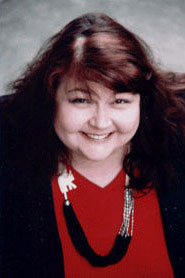
Lynne Murray knew she wanted to write a novel featuring a fat heroine with a take-no-prisoners attitude when the book hit the wall. She threw the novel she was reading when she reached a page where the book's heroine sneers at a fat character. It was one fat joke too many. She had to do something.
She wasn't sure how to create a fat fictional character who refused to be ignored or disrespected. It turned out that what she had to do was become a self-accepting woman of size in the process of writing about one.
Larger Than Death, the first book in the mystery series featuring Josephine Fuller, a sleuth of size who doesn't apologize, won the National Association to Advance Fat Acceptance (NAAFA) Distinguished Achievement Award.
In Bride of the Living Dead, she set out to write a romantic comedy about love and marriage. She conjured up a rebellious, plus-sized heroine whose idea of dressing up is wearing a monster movie T-shirt and jeans to go to the movies. Yet Bride of the Living Dead finds heroine Daria MacClellan trapped into a formal wedding with her anorexic, perfectionist older sister planning the whole thing.
Murray's humorous short pieces have appeared in magazines and newspapers. Many of these articles, including an interview with Darlene Cates, star of What's Eating Gilbert Grape, are available on her website at www.lmurray.com. She is also a regular contributor to the Body Impolitic blog.
Murray went to San Francisco to go to college and ended up staying. She received a B.A. in psychology from San Francisco State University. The city is the setting for Bride of the Living Dead and has been the setting for most her her fiction since her first book, Termination Interview, was published in 1988.
Murray shares an apartment with a small group of extremely mellow cats, who are all either rescued or formerly feral.
<p>Emerging from the long shadow cast by his formidable father, Harold Godwineson showed himself to be a worthy successor to the Earldom of Wessex. In the following twelve years, he became the King's most trusted advisor, practically taking the reins of government into his own hands. And on Edward the Confessor's death, Harold Godwineson mounted the throne—the first king of England not of royal blood. Yet Harold was only a man, and his rise in fortune was not blameless. Like any person aspiring to power, he made choices he wasn't particularly proud of. Unfortunately, those closest to him sometimes paid the price of his fame.<br /><br />This is a story of Godwine's family as told from the viewpoint of Harold and his younger brothers. Queen Editha, known for her Vita Ædwardi Regis, originally commissioned a work to memorialize the deeds of her family, but after the Conquest historians tell us she abandoned this project and concentrated on her husband, the less dangerous subject. In THE SONS OF GODWINE and FATAL RIVALRY, I am telling the story as it might have survived had she collected and passed on the memoirs of her tragic brothers.<br /><br />This book is part two of The Last Great Saxon Earls series. Book one, GODWINE KINGMAKER, depicted the rise and fall of the first Earl of Wessex who came to power under Canute and rose to preeminence at the beginning of Edward the Confessor's reign. Unfortunately, Godwine's misguided efforts to champion his eldest son Swegn recoiled on the whole family, contributing to their outlawry and Queen Editha's disgrace. Their exile only lasted one year and they returned victorious to London, though it was obvious that Harold's career was just beginning as his father's journey was coming to an end.<br /><br />Harold's siblings were all overshadowed by their famous brother; in their memoirs we see remarks tinged sometimes with admiration, sometimes with skepticism, and in Tostig's case, with jealousy. We see a Harold who is ambitious, self-assured, sometimes egocentric, imperfect, yet heroic. His own story is all about Harold, but his brothers see things a little differently. Throughout, their observations are purely subjective, and witnessing events through their eyes gives us an insider’s perspective.<br /><br />Harold was his mother's favorite, confident enough to rise above petty sibling rivalry but Tostig, next in line, was not so lucky. Harold would have been surprised by Tostig's vindictiveness, if he had ever given his brother a second thought. And that was the problem. Tostig's love/hate relationship with Harold would eventually destroy everything they worked for, leaving the country open to foreign conquest. This subplot comes to a crisis in book three of the series, FATAL RIVALRY.</p>
In modern-day San Francisco, Sir John Falstaff, the charming rogue made famous by Shakespeare in his play <em>Henry V, </em>is a centuries-old vampire who has lost none of his captivating manner, especially where ladies are concerned. Seeking his assistance is widowed psychologist Kristin, who has stumbled into a vampiric quagmire through the machinations of her two-timing boyfriend, who wants desperately to become a vampire and have the power to change the world. At his side he wants the young Mina, rather than the older Kristin, who happens to be Mina's shrink. Then there is Violet, the carefree neighbor who writes vampire romance novels and feeds the neighborhood's stray cats, and Bram, who spends his time researching vampire cults. Murray<em> (Bride of the Living Dead)</em> combines rich storytelling with humor to spin a fun, exciting tale."